Periodic patterns in Web log time series

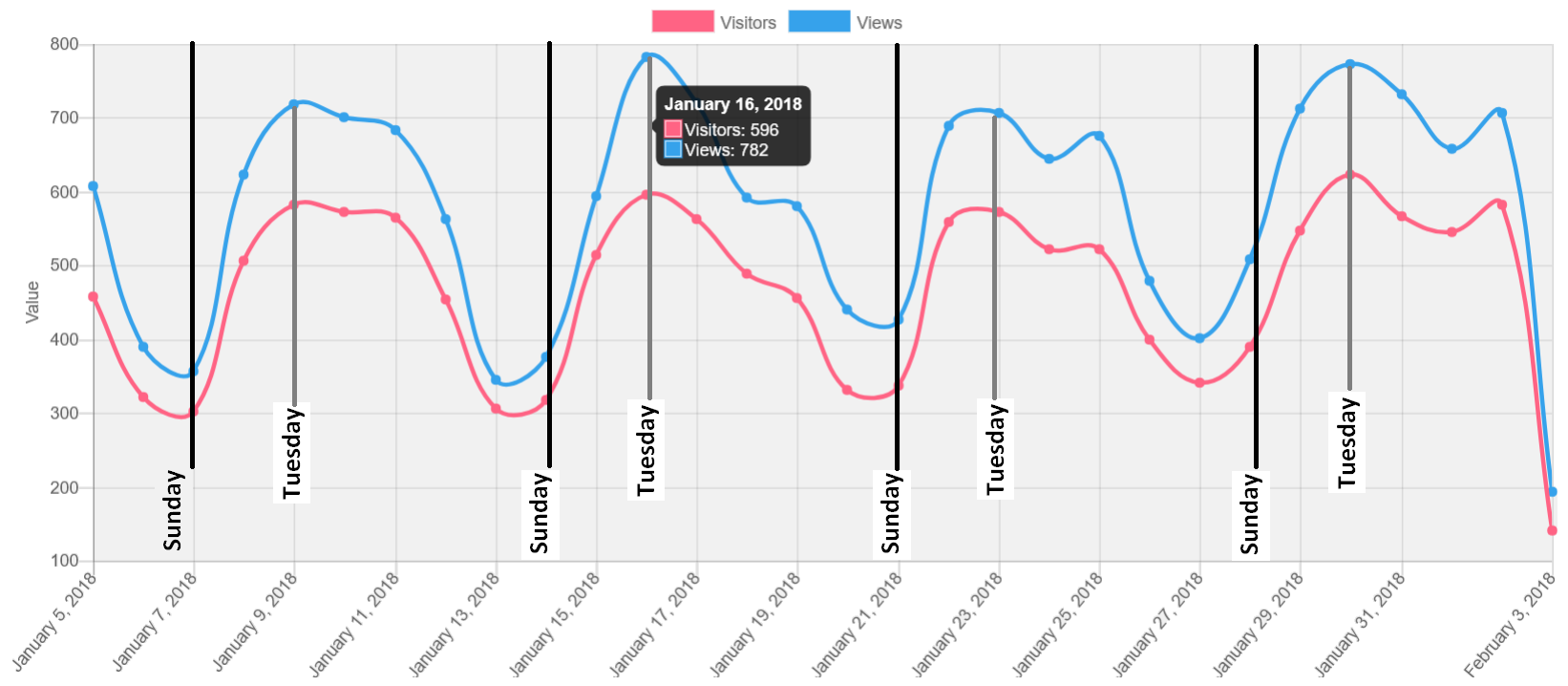
Recently, I have analysed trends about visitors on this blog. I have made two observations. First, there is about 500 to 1000 visitors per day. For this, I want to thank you all for reading and commenting on the blog.  Second, if we look carefully at the number of visitors per day, it becomes a time series, and we can clearly see some patterns that is repeating itself every week. Below is a picture of this time series for January 2018.

periodic visitor accesses

As you can see, there is a clear pattern every week. Toward the beginning of the week on Monday and Tuesday, the number of visitor increases, while around Friday it starts to decrease. Finally, on Saturday and Sunday, there is a considerable decrease, and then it increases again on Monday. This pattern is repeating itself every week. We can see it visually, but such patterns could be detected using time series analysis techniques such as an autocorrelation plot. Besides, it would be easy to predict this time series using time series forecasting models.

We can also see a relationship with the concept of  periodic patterns that I have previously discussed in this blog. A periodic pattern is pattern that is always repeating itself over time.  That is all for today. I just wanted to shared this interesting finding.


Philippe Fournier-Viger is a professor of Computer Science and also the founder of the open-source data mining software SPMF, offering more than 150 data mining algorithms.

Posted in Big data, Data Mining, Data science, Time series | Tagged , , , , , | Leave a comment

What I dislike about academia

In this blog post, I will talk about academia. There are numerous things that I like about academia, and I really enjoy working in academia. But for this blog post, I will try to talk  about what I don’t like in academia to give a different perspective.

academia

Even when we like something very much, there is always some things that we don’t like. So, here we go. Here is a list of some things that I more or less dislike in academia:

  • A sometime excessive pressure to publish: There is sometimes a great pressure on researchers to produce many publications in a given time frame, which may come from various sources. It is in part necessary as it increases productivity and ensures that researchers do not become lazy. But a drawback is that some researchers may be less willing to take risks or may focus on short-term projects rather than on more difficult but more rewarding projects.
  • Conflicts of interests at various levels. A researcher should avoid conflicts of interest. However, not everyone does and this is a problem. A few years ago, for example, I was a program committee member of a conference and discovered that a reviewer reviewed his own paper. I reported this issue to the conference organizers and that person was kicked out of the program committee. Another, example is some journal reviewers that always ask that we cite their papers in their reviews even if it is not relevant to our paper, just to increase their citation count. In my field, there is one reviewer that is especially known for doing this as several researchers talked to me about him. This is not a good behavior and I usually report it to the journal editor but since reviewers work for free, there is typically no consequence for such people. A third example is that some researchers will often give preferential treatment to their friends. For example, I ever attended a conference  where three of the awards were handed to collaborators of the conference organizer. Although these papers may be good, it remains suspicious. Another example is when I was applying for jobs in Canada, several years ago. At that time, I was one of remaining two candidates for a professor position but finally the other much less experienced researcher was chosen, due to a likely conflict of interest.
  • Predatory journals and conferences. There are many journals of very low quality that only publish to earn money. These journals usually have very broad scope, are published by unknown publishers and sometimes appear to not review papers. They also often send spam to promote their journals. This is a problem, and I obviously dislike such journals.
  • Unethical publications by some researchers. I have discovered and reported several journal papers that contained plagiarism. These papers have been generally retracted, as they should. But in some cases, unethical behavior is not so easy to detect. For example, I have ever read some papers where I thought that results were fake but there was not enough evidences to prove it. It certainly happens that some researchers publish fake results, which is bad for academia.
  • Publishers that sometimes are too greedy. It is well known that some publishers charge very high fees to universities and individuals to publish and/or access research publications. This is somewhat unfortunate because research is often funded by a government, done by researchers and reviewed for free by reviewers, while publishers are those earning money. It would be difficult to change this as popular publishers are well established and there are pressure to keep this system. On the other hand, this publication system is not that bad. Actually, the good publishers will filter many bad papers, and ensure minimum quality levels for papers, which is important.
  • Insufficient funding for research in some countries. Currently, I have a lot of funding so I cannot complain about insufficient funding. But in some other countries, funding is quite rare and often insufficient for researchers in academia. This was the case when I was working in Canada. To apply for the national funding by NSERC, we would have to write a budget requesting large amounts of money but one was considered lucky to even just get a fraction of it. Thus not so much money was available to students, for attending conferences and publications, and buying equipment. Besides, there is not enough professors at several universities in countries like Canada.
  • Reviewers that do not do their job well. As researchers, our work are evaluated by other researchers to determine if our work should be published in a given conference proceedings or journal. Generally, reviewers do a good job and do it for free, which is very appreciated. However, in some cases, reviewers don’t do their job correctly. For example, it ever happened to me that a reviewer rejected my paper because he thought the problem could be solved in a more simple way. But the solution proposed by the reviewer in his review was wrong. Having said that, a reviewer often misunderstand a paper because it is not well written. Thus, such situations are often to be blamed on authors rather than reviewers. And often when a paper is rejected there are multiple problems in the paper.
  • Unprofessional behavior. In some cases, some researchers have highly unprofessional behavior. This was for example the case for the ADMA 2015 conference, which was canceled without notifying authors, after papers had been submitted. The website just went offline and organizers just ignored emails.
  • Bad paper presentations. I have attended many international conferences. Sometimes paper presentations are good. But sometimes they are not good. There are several easily avoidable mistakes that a presenter should not do such as turning is back to the audience, exceeding the time limit, and not being prepared.

This is all for today! I just wanted to share some things that I don’t like about academia. But actually, I really like academia. You can share your own perspective on academia in the comments below, or perhaps that you may want to share solutions on how to improve academia. 😉


Philippe Fournier-Viger is a professor of Computer Science and also the founder of the open-source data mining software SPMF, offering more than 150 data mining algorithms.
Posted in Academia, Research | Tagged , , , | Leave a comment

News about the data mining blog

This data mining blog has been created more than five years ago and has had a considerable success with more than 800,000 views. For this, I want to thank all the readers. Today, I will announce some important news related to this blog.

Translation of the blog

The first news is that the blog will be translated to make it more accessible in other languages. Since I work in China and there is a very large Chinese data mining community, I have recently added a Chinese translation of the data mining blog. It can be accessed by clicking the following link in the menu of this website.

chinese blog

In the Chinese version of the data mining blog, not all blog posts will be translated, but the most important ones.  Currently four posts have been translated. I have published two and the others will be published in the following weeks.

chinese data mining

I am also considering adding a French translation since I am a native French speaker.  Other languages could also be added such as Vietnamese and Spanish if volunteers are willing to help me translating to other languages.

Video tutorials about data mining and big data

The second news is that I am currently experimenting with software to record lectures and publish them online as HTML5 videos. In the near future, I will start publishing  various videos about data mining. This will include some lectures that I have given, as well as some tutorials for my SPMF data mining software. I will also record some video tutorials to present some classical data mining algorithms. Moreover, I will discuss why recording videos can be useful to promote research, in a future blog post.

Conclusion

In this blog post, I have given some news about future plans for the blog. Thanks again for reading and commenting. I am also looking for contributors. If you would like to contribute as a guest author or translator, just let me know.


Philippe Fournier-Viger is a professor of Computer Science and also the founder of the open-source data mining software SPMF, offering more than 150 data mining algorithms.
Posted in General | Tagged | Leave a comment

Report about the DEXA 2018 and DAWAK 2018 conferences

This week, I am attending the DEXA 2018 (29th International Conference on Database and Expert Systems Applications) and the DAWAK 2018 (20th Intern. Conf. on Data Warehousing and Knowledge Discovery) conferences from the 3rd to 6th September in Regensburg, Germany.

dexa 2018 dawak 2018

Those two conferences are well established European conferences dedicated mainly to research on database and data mining. These conferences are always collocated. It is not the first time that I attend these conferences. I previously attended  DEXA 2016 and DAWAK 2016 in Portugal.

These conferences are not in the top 5 of their fields but are still quite interesting, usually with some good papers. The proceedings of the conference are published by Springer in the LNCS (lecture notes in Computer Science series, which ensures that the paper are indexed by various academic databases.

Acceptance rates

For DEXA 2018, 160 papers were submitted, 35 have been accepted (22.%) as full papers, and 40 as short papers (25 %).

For DAWAK 2018, 76 papers were submitted, 13 have been accepted (17.%) as full papers, and 16 as short papers (21 %).

Location

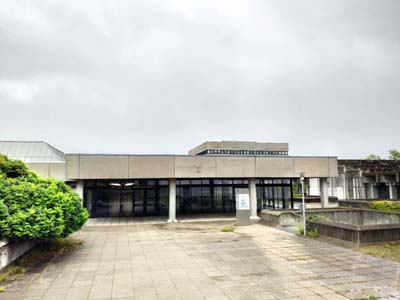
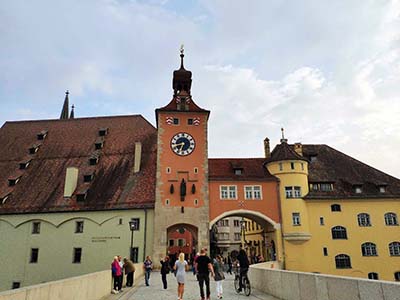
The conference is held at University of Regensburg, in Regensburg, a relatively small town with a long history, about 1 hour from Munich. It is a UNESCO world heritage site. The university:

dexa 2018 location

A picture of the old town:

regensburg dexa

Why I attend these conferences?

This year, my team and collaborators have four papers at these conferences, on topics related high utility itemset miningperiodic pattern mining and privacy preserving data mining:

  • Fournier-Viger, P., Zhang, Y., Lin, J. C.-W., Fujita, H., Koh, Y.-S. (2018). Mining Local High Utility Itemsets . Proc. 29th International Conference on Database and Expert Systems Applications (DEXA 2018), Springer, to appear.
  • Fournier-Viger, P., Li, Z., Lin, J. C.-W., Fujita, H., Kiran, U. (2018). Discovering Periodic Patterns Common to Multiple Sequences. 20th Intern. Conf. on Data Warehousing and Knowledge Discovery (DAWAK 2018), Springer, to appear.
  • Lin, J. C.-W., Zhang, Y. Y., Fournier-Viger, P., … (2018A heuristic Algorithm for Hiding Sensitive Itemsets. 29th International Conference on Database and Expert Systems Applications (DEXA 2018), Springer, to appear.
  • Lin, J. C.-W., Fournier-Viger, P, Liu, Q., Djenouri, Y., Zhang, J. (2018Anonymization of Multiple and Personalized Sensitive Attributes. 20th Intern. Conf. on Data Warehousing and Knowledge Discovery (DAWAK 2018), Springer, to appear.

The two first papers are projects of my master degree students, who will also attend the conference.  Besides, I will also chair some sessions of both conferences.

Another reason for attending this conference is that it is an European conference. Thus, I can meet some European researchers that I usually do not meet at conferences in Asia.

Day 1

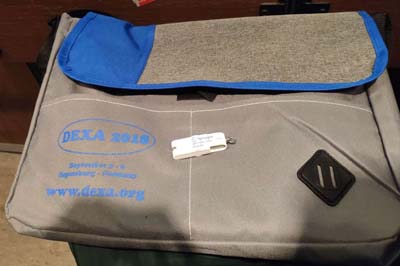
I first registered. The process was quick. We receive the proceedings of the conference as a USB drive, and a conference bag.

dexa 2018 proceedings

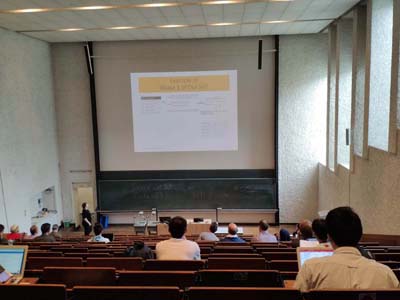
I attended several talks from both the DEXA 2018 and DAWAK 2018 conference on the first day. Here is a picture of a lecture room.

dexa 2018 lecture

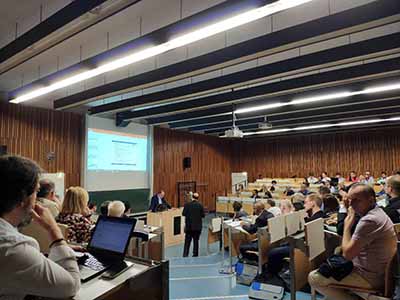
There was also an interesting keynote talk about database modelling.

dexa keynote

In the evening, a reception was held at the old town hall.

Day 2

The second day had several more presentations. In the morning I was the chair of the session on classification and clustering. A new algorithm that enhance the K-Means clustering algorithm was proposed, which has the ability to handle noise. An interested presentation by Franz Coenen proposed an approach were data is encrypted and then transmitted to a distant server offering data mining services such as clustering. Thanks to the encryption techniques, privacy can then be ensured. In the morning, there was also a keynote about “smart aging”. I did not attend it though because I instead had a good discussion with collaborators.

Day 3 – Keynote on spatial trajectory analysis

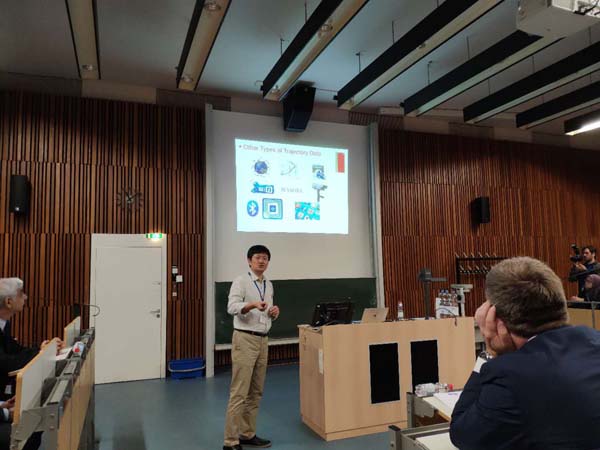
There was a keynote about “Spatial Trajectory Analytics: Past, Present and Future” by Xiaofang Zhou. It is a timely topic as nowadays we have a lot of trajectory data in various applications.

dexa trajectory data keynote

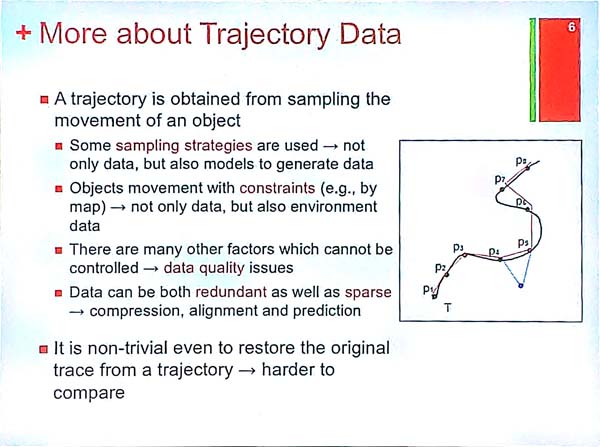
What is trajectory data? It is the traces of moving objects. Each object can be described using time, spatial positions and other attributes. Some examples of trajectory data is cars that are moving. Such trajectory data can be obtained by the GPS of cars. Another example is the trajectory of mobile phones. Trajectory data is not easy to analyze because it samples the movement of an object. Besides, trajectories are influenced by the environment (e.g. a road may be blocked). Other challenges is that data may be inaccurate and some data points may be redundant.

trajectory data

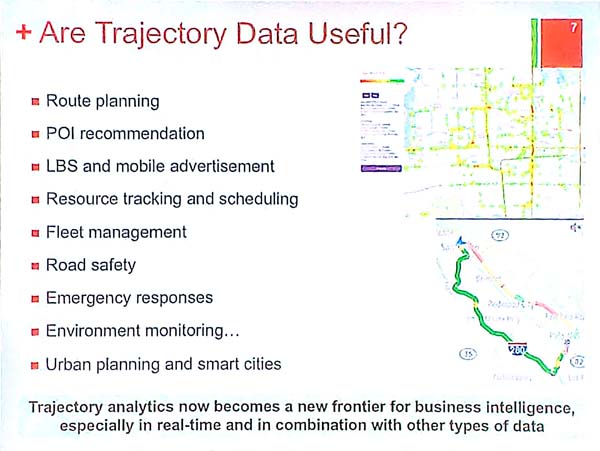
Trajectory data can be used in many useful ways such as route planning, point of itnerest recommendation, environment monitoring, urban planning, and resource tracking and scheduling. Trajectory data can also be combined with other types of data.

trajectory data applications

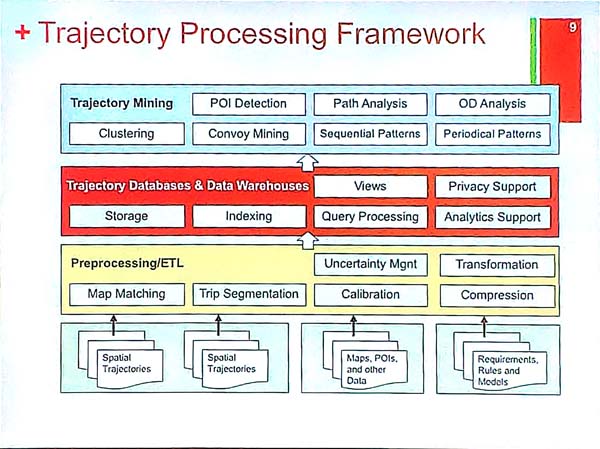
But how to process trajectory data? Basically, we need to monitor the objects to collect the trajectories, store them in databases (which may provide various views, queries, privacy support, and indexing), and then the data can be analyzed (e.g. using techniques such as clustering, sequential pattern mining or periodic pattern mining). Here is a proposed architecture of a trajectory analysis system:

trajectory data analysis

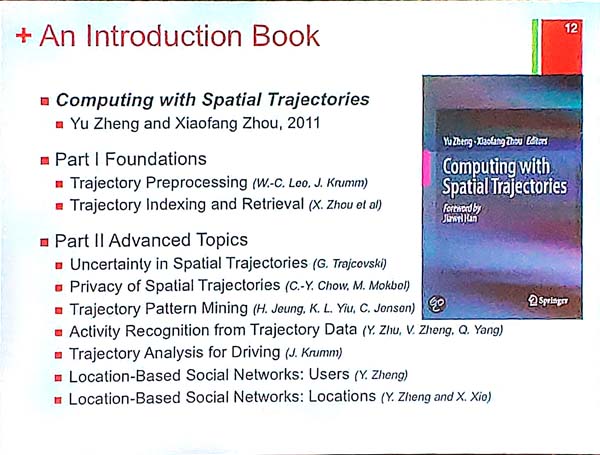
This is a first book written by the presenter in 2011 about spatial trajectory mining:

trajectory data book

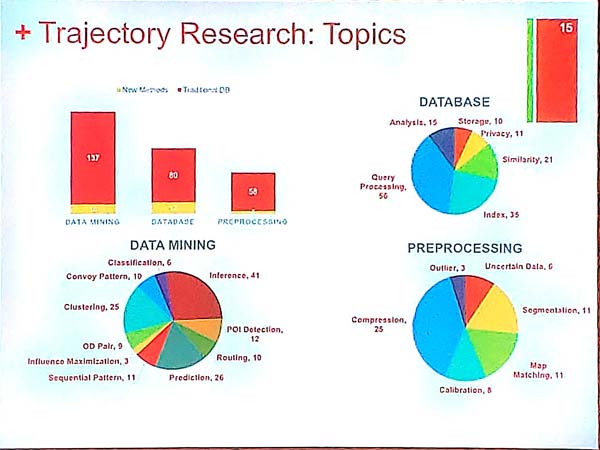
Here are some important topics in trajectory analysis:

trajectory analysis research topics

Then, the presenter discusses some specific applications of trajectory data analysis. Overall, it was an interesting introduction to the topic.

Day 3 – Banquet

In the evening, attendees were invited to a tour of a palace, and then to a banquet in a German restaurant.

dexa dawak banquet

Day 4

On the last day, there was more paper presentations and another keynote.

Next year

DAWAK 2019 and DEXA 2019 will be hosted in Linz, Austria from the 26th to the 29th August 2019.

Best paper award

The best paper award was given to the paper “Sequence-based Approaches to Course Recommender Systems” by Osmar Zaiane et al. It presents a system to recommend undergraduate courses to student.  This system, applies algorithms for sequential pattern mining and  sequence prediction among other to select relevant courses.

Conclusion

Overall, the quality of papers was relatively high, and I was able to meet several researchers related to my research. It was thus a good conference to attend.

Update: You may also be interested to read my newer posts about DEXA and DAWAK 2019, and DEXA and DAWAK 2021.


Philippe Fournier-Viger is a professor of Computer Science and also the founder of the open-source data mining software SPMF, offering more than 150 data mining algorithms.

Posted in Big data, Conference | Tagged , , , , , , | 4 Comments

China lead in mobile payment and services

In this blog post, I will talk about the wide adoption of mobile payment and mobile services in China. I have been working in China for several years and I am still quite amazed by everything that can be done with a cellphone there.

mobile payment in China

China’s mobile payment systems

A fundamental difference with many western countries is that mobile payment is widely used in China and that virtually everything can be paid with a cellphone, from buying something from a street vendor to paying a bill in a restaurant, or transferring money to a friend.

There are two main mobile payment systems in China called WeChat (by Tencent) and Alipay (by Alibaba). To use a mobile payment systems, one needs to download an application  on his cellphone and validate his identity, and generally link the application to a bank account for transferring money to the virtual wallet. This can be done in just a few minutes.  I will describe the main functions of these applications below.

The core function of Wechat is messaging. It allows to  maintain a list of friends and send messages, and make voice/video calls. But Wechat can also be used for mobile payments.  The main payment features are:

  • Transferring money from a bank account to the virtual Wechat wallet to refill it.
  • Sending money to a friend.
  • Sending money or receiving money from someone else by scanning a QR code on his cellphone or let him scan your QR code.
  • Pay a bill at a store. This requires to scan the QR code of the store with the cellphone and then enter the amount of money and password. Then, the store owner receives the money. Another way is to let the store owner scan your QR code to withdraw money from your account.
  • Pay for a wide variety of services such as:
    • Pay utility bills such as water, electricity
    • Pay the bills of your cellphone
    • Order food to be delivered to your door.
    • Order food at the restaurant by viewing the menu on the cellphone, and selecting items.
    • Order a taxi or ride
    • Rent a public bike by scanning the QR code of the bike,
    • Order cinema tickets,
    • Reserve airplane/train tickets/ hotel room
    • Use your cellphone as a ticket in the bus/subway if the cellphone has NFC technology
    • Buy products from online retail stores
    • Send money to charity
    • and many others

The other main payment system is Alipay.  Unlike Wechat,  Alipay is not a messaging application. It is designed for mobile payment and is actually more popular than Wechat. It offers mostly the same functions. Besides, some other functions that I did not mention above are:

  • Pay a credit card
  • Split the bill between friends at a restaurant
  • Buy game
  • Buy lottery

The Wechat and Alipay mobile payment systems are widely used, everyday by hundreds of millions of people. I know many people in China that basically use this to pay for everything in their daily life, and don’t use cash anymore. Actually, mobile payment is often the preferred way of payments in several stores.  For example, I recently bought some milk tea at a store and the employee asked me to pay with Alipay instead of money because he did not have change.

This is quite different from many western countries where mobile payment is rarely used. For example, Business Insider (https://www.businessinsider.com/alipay-wechat-pay-chinamobile-payments-street-vendors-musicians-2018-5/ ) revealed in May 2018 that the mobile payment market in China is valued at 16 trillions, while in the US, it is only 112 billions. In other words, the mobile payment market is more than 140 times larger in China than in the US.

What is the reason for the wide adoption of mobile payment in China? 

There are several reasons:

  • Cellphone plans are very cheap. Thus, many people has a cellphone with a data plan.
  • Using these payment systems is very simple.  To pay, one scans a QR code or let someone scan his QR code. Then, he enter his password to authorize the payment. It can be done for any kind of transactions, between individuals or at a store.  Anyone can receive or send money.
  • There is no fee to pay using these payment systems. For example, the only fee that Wechat charges is 0.1 % when transferring money back from a virtual wallet to a bank account (if the amount exceed 1000 RMB, which is about 150 $ USD). These fees are almost nothing compared to processing fees of credit cards or  debit card in many western countries.
  • Creating a mobile payment account is simple and basically just require to link the account to a bank account. This is much easier than getting a credit card, since mobile payment systems are not used to borrow money

Impact on innovation and adoption of mobile services

The fact that mobile payments are widely used in China has started to transform many aspects of daily life. For example, at the restaurant, it is possible to scan a QR code on a table to see the menu and then order food, which will then be delivered to the table. Another example is to scan the QR code of a bike on the street to unlock the bike, pay to use it, and then leave it anywhere after using it.  A third example, is to go to restaurant with friend, and then split the bill or quickly transfer money between phones, or use the phone to pay in the bus or subway. A fourth example, is to pay at a vending machine using by scanning a QR code.

The wide usage of mobile payment creates huge opportunities for the development of innovative mobile services in China, that cannot be offered on a large scale in other countries.  Thus, I believe that is a key advantage that helps drive innovation in China for mobile services.

Conclusion

In this blog post, I discussed the adoption of mobile payment and mobile services in China. Hope that it has been interesting! If you have any comments, please write it in the comment section below.


Philippe Fournier-Viger is a professor of Computer Science and also the founder of the open-source data mining software SPMF, offering more than 150 data mining algorithms.

Posted in General | Tagged , , , | Leave a comment

Why doing a Ph.D.?

Why donig a PhD

In this blog post, I will answer the question: Why doing a Ph.D.?  This is an important question for several students that are doing a bachelor or master degree,. Taking a good decision is important as doing a Ph.D requires several years of work. But at the same time, obtaining a Ph.D. can be very rewarding.  In this blog post, I will first briefly explain what is the goal of doing a PhD., and then discuss the reasons for doing it and for NOT it.

What is the goal of doing a Ph.D.?

Put in a simple way, the goal of doing a Ph.D. is to learn how to do research. At the end of a Ph.D. one should be able to independently do research, and work as a researcher. Moreover, during the Ph.D., one should make some novel and significant contributions to research in his fields.

What are the reasons for doing a Ph.D?

Some of the main reasons are:

  • Becoming an expert in a field. By doing a Ph.D. one may become an expert on a specific topic, and work with other experts in that field with state-of-the-art equipment on state-of-the-art problems. If you like learning, just like me, this is very satisfying.
  • Contribute to the advancement of knowledge. By doing research, one can contribute to the advancement of knowledge in a specific field. For example, one can make new discoveries that are useful to other people.
  • Work on something that you like. When doing a Ph.D. one can actually choose to to work on something that he like for a few years. This is something that is not always possible when working in a company.
  • Self-achievement. One can see the Ph.D. as a challenge. One of the reasons why I decided to do a Ph.D. is to test myself to see if I could do it.
  • It is a requirements for some jobs. Although not many jobs requires a Ph.D., some jobs like researcher and university professor requires to have a Ph.D. If one wants to do such jobs, he definitely needs to get a Ph.D. Working as a researcher can be very motivating as it requires to use problem-solving skills everyday.
  • Money (in the long term). A Ph.D. actually does not guarantee earning more money than someone who does not have a Ph.D. But in many cases having a Ph.D. can lead to a good salary, especially if one studies in science, technology and engineering.
  • The title? You can call yourself a “doctor”. 😉 I am just kidding. It is nice to have that title. But one should NOT see this as a reason for doing a Ph.D.
  • Spending a few more years as a student.  Although being a student should not be a reason for doing a Ph.D., many Ph.D. students enjoy the freedom that Ph.D. students have. As a student, there is often more freedom than when working in a company. Thus living as a student for a few more years to do a Ph.D. can be positive.
  • Travelling. Graduate studies are a good opportunity for travelling such as to attend international conferences to present your work, or even in some cases to study abroad.

What are the reasons for NOT doing a Ph.D.?

Some of the main reasons for not doing a Ph.Ds are:

  • Time! Doing a Ph.D. requires to spend typically at least 3 years of your life to work on a specific project. For me, that was never an issue, but some people may worry about this. Besides, the end of the Ph.D typically depends on how fast one can complete the project. Some people who are not good at research or are working part-time may spend 4 or 5 years.
  • Money (in the short term). It depends on the country, but it is a possible that a Ph.D. student does not earn a great amount of money during his studies. This means to live with a small amount of money for a few more years, perhaps. Some people do not like to live like students, while some other people enjoy the student life.
  • Money (in the long term).  Although some jobs that require a Ph.D. are very well paid, there exists some jobs that do not require a Ph.D. and can be paid better. Thus, one should not just think about money when deciding to do a Ph.D.
  • Some jobs do not require a Ph.D. Although getting a Ph.D. can help someone acquire many skills especially about research and writing, some people who have a Ph.D. may actually end up doing some jobs that do not require a Ph.D.
  • Pressures from others. One should not do a Ph.D. if it is only because of the pressures of parents or family. One should really be interested in doing the Ph.D. for himself.
  • It requires at lot of work.  Obtaining a Ph.D. requires a few years of hard work. Some people can easily cope with this, while others do not like to work hard. Working for a few years on a project can at times be hard, and some people do not feel motivated. However, if you like research like me, it is actually very motivating.

Conclusion

In this blog post, I have discussed the main reasons for doing a Ph.D. If you think about other reasons or want to share your opinion about this topic, please post in the comments below. Also, you may be interested to read my related post about: what it takes to do a good Ph.D?

==
Philippe Fournier-Viger is a full professor  and the founder of the open-source data mining software SPMF, offering more than 140 data mining algorithms. If you like this blog, you can tweet about it and/or subscribe to my twitter account @philfv to get notified about new posts.

Posted in Academia, Research | Tagged , | Leave a comment

How to review a research paper?

Today, I will discuss the task of reviewing papers in academia. I will discuss why it is important to review papers, and then give tips about how to review papers and also talk about what a reviewer should do and should not do. This topic is important for young researchers who are invited to review research papers for conferences and journals, and want to do this task well.

how to review a paper?

Why reviewing paper is important?

From the perspective of authors and publishers, the review process in academia is important  as it ensures that papers meet some quality standard before they are published.  Moreover, the review process is used to filter out papers that do not meet the requirements of the journal in terms of quality or other criteria (e.g. a paper should not contain plagiarism). The review process is also important as reviewers can provide constructive comments to help authors improve their paper, even when the paper is rejected.

From the perspective of reviewers, reviewing papers is also important. There are a few reasons. First, it means that the reviewer is recognized as having enough expertise to review papers. For example, if you are invited to review papers for some famous journals, you can mention it in your CV and on your website, as it shows that some famous journals are trusting you for doing reviews. This kind of experience is valuable in academia, but not so much for the industry.  Second, by doing reviews, a reviewer can get a glimpse of the latest research that is unpublished in the field. Of course, a reviewer should always be profesionnal and not take advantage of this information. In fact, a reviewer should only use information about unpublished papers for the purpose of reviewing, and should not share information with other people about reviews. But it can still give a broad overview of what other people are working on to the reviewer, for example to know what topics are popular in general. In that sense, it can be interesting. Third, by reviewing papers, you can also know more about how other people will review your papers. In other words, it helps you to think like a reviewer, and write better papers because you will anticipate problems that the reviewers could raise in your paper. Fourth, by reviewing paper, the reviewer can feel that he is helping the research community.

Is there a drawback to review papers?   

Yes, of course, there is.  The drawback is that it takes quite a lot of time, and in life, we have a limited amount of time. Personally, I receive a lot of requests to do reviews from journals. At first, I was accepting all of them when I was a Ph.D. student or early in my career. But now, I decline many of them because otherwise it will take too much of my time. So I usually only review the papers that are related to my field and for the top journals and conferences. If I receive some offer to review papers that are unrelated to what I am doing or from journal or conferences that I never heard of, I will decline the invitation. There is of course some exceptions. For example, if a friend ask me to review for his journal, I will usually say yes even if the paper is not too much related to what I am doing.  Actually, you can consider the job of a reviewer as free work as the reviewers usually never get paid. In fact, in academia, the publisher typically earns money by selling the papers that are written and reviewed for free by researchers (for typical non open-access and free journals), which is a strange model but it is how it works.

How to review a paper?

Now that I have explained why reviewing papers is important. I will present some criteria that a  reviewer should use in general to evaluate a paper. Of course, depending on the research field, some of these criteria may be more or less relevant.

  • Is the paper easy to understand and well-written? 
  • Does the paper follows the format required by the conference or journal?
  • Does the title of the paper is appropriate and describe the content of the paper?
  • Does the abstract accurately describes the content of the paper?   In particular, it should explain why the problem addressed in the paper is important, describe the contributions and briefly talk about results.
  • Does the introduction explains why the problem addressed in the paper is important?
  • Does the introduction discusses limitations of previous work?
  • Does the paper clearly explains what are the new contributions made in the paper with respect to previous work?Are some important citations missing?  Are the references too old?
  • Does the paper contains plagiarism? Several papers that are submitted to conferences and journals contains plagiarized content.  When I review a paper, one of the first thing that I do is check for plagiarism. I copy some sentences from the paper and search for these sentences using a Web search engine to see if the paper has already been published or contains a considerable amount of text from another paper. If there is plagiarism, I directly reject the paper.
  • Does the proposed solution is described with enough details?  For example, if someone is proposing a new data mining algorithm, does all the details of the algorithm are provided or is some important details missing?
  • Is the paper technically sound? In other words, is there some technical errors in the paper (e.g. some lemma or theorem are incorrect). Does some important technical details are missing? Do the authors make some formal proofs (if necessary in his field) that their solution is correct?
  • Does the experiments are appropriate to evaluate the proposed solution? A proposed solution should ideally be compared with solutions from other researchers and a fair experiment should be done to evaluate whether the proposed solution is better.  Also,  the experiments should be designed to evaluate what needs to be evaluated in the paper.

Besides, a reviewer should:

  • Give a fair evaluation of what is good and what is bad in the paper.  It is important to be fair and review the papers of other people in a fair way, just like we would like other people to review our paper.
  • Provide constructive comments. When reviewing a paper, it is important to give constructive comments about how to improve the paper if it needs to be improved. This will help to improve the paper.

And a reviewer should NOT:

  • Perform a review if there is a conflict of interest.  A reviewer should not write a biased review. The review process should be neutral. The definition of a conflict of interest depends on the journal or conference. But generally, a conflict of interest can occur when a reviewer is invited to review his own paper or the paper of someone closely related to him such as a collaborator during the last few years or family member.  Other types of conflict of interests also exist such as reviewing the paper of someone who is in competition with the reviewer in terms of research (for example, to reject papers of competitors in a biased way). As a reviewer, one should avoid conflicts of interests.  But it still happen quite often. For example, as a program committee member of an international conference, I have found that one of the reviewer was trying to review his own paper, a few years ago. I informed the organizers of the conference and they then banned that person from the committee of  that conference, as it is a very serious academic misconduct.
  • Share or use the information about unpublished papers for other purposes than reviewing the paper. A reviewer has access to papers that are unpublished. It is the responsibility of the reviewer to follow the rules of the journal/conference and not share the unpublished papers with unauthorized persons, and also not use information in the unpublished papers for any purposes other than to review the papers.  I will tell you a short story about that. A few years ago, I submitted a paper to PKDD 2012. My paper was rejected but then I found using a web search engine that my paper was online on the webserver of one of the reviewer. I sent an e-mail to PKDD to complain about this, as my paper was unpublished and should not be shared online by a reviewer.  The, the reviewer removed the paper and sent me an apology. He explained that he just put my paper on his server with other papers because he was travelling and use it as a storage space. He then removed the paper.

The Review Generator

You can also try a website that I have developed to help generate a review draft called the paper review generator:

Conclusion

In this blog post, I have discussed why reviewing papers is important, how to review papers, and talked about what a reviewer should do and not do. I tried to give as much information as possible. If you think that I forgot something important or if you have some interesting story, please post it in the comments below. I will be happy to read it.

==
Philippe Fournier-Viger is a full professor  and the founder of the open-source data mining software SPMF, offering more than 140 data mining algorithms. If you like this blog, you can tweet about it and/or subscribe to my twitter account @philfv to get notified about new posts.

Posted in Academia, Research | Tagged , , , , | Leave a comment

Report about the KDD 2018 conference

This week, I am participating to the KDD 2018 ( 24th ACM SIGKDD Intern. Conference on Knowledge Discovery and Data Mining), in London, UK from the 19th to 23rd August 2018.

KDD 2018 london

The KDD conference is an international conference, established 24 years ago. It is the top conference in the field of data mining / data science / big data.  The proceedings are published by ACM. This year, more than 3,000 persons were registered at the conference, which is huge. Many researchers from the industry are attending the conference.  KDD was held at the Excel convention center:

kdd london excel

Day 1 – Registration

On the first day, the registration started at 7:00 AM and the tutorials started at 8:00 AM. I arrived at around 7:45 and had to wait about 20 min in line to register. The problem was that there was hundreds of people who all wanted to register at the same time and maybe only six volunteers to serve them. Thus, several people arrived late at the tutorials.  However, I don’t blame the organizers because this is something hard to avoid for such big conferences, and this year it is a record for attendance.  This is the waiting lines:

The  registration desk:

kdd registration

We receive a conference bag containing a USB stick with the proceedings, a pen, notebook and various promotional materials from businesses.

An APP called Whova was offered for our cellphones. This APP allows to see all the attendees from the conference, to create discussion groups and to see the schedule of the conferences. These three features are respectively shown in the three screenshots below.

Day 1 – Tutorials

After registration, I attended a tutorial about data mining in online retail stores, organized by JD.com (jingdong). I also attended a tutorial on fact checking in the afternoon and part of the workshop on explainable models for healthcare. Actually, there was more than 10 tutorials at the same and many seem interesting but I could not attend all of them!

Day 2 – The 1st International Workshop on Utility-Driven Mining (UDM 2018)

This year, I co-organized the first UDM 2018 workshop on utility mining. The workshop is about finding patterns in databases that have a high utility or importance (e.g. high profit). The workshop program included a keynote by Nitesh Chawla about decision-making, which was unfortunately cancelled due to unexpected events. However, we still had a great workshop with seven paper presentations. The published papers can be found on the workshop page.  Among these papers, here is a brief description of some interesting ideas:

All the presentations have been recorded and will be made available online in the future. Besides, a special issue in a Springer journal is being organized for the best papers, and a Springer book is planned for the proceedings of the workshop.

Day 2 – Opening ceremony

The opening ceremony was also on the second day. Here is some pictures about the location and some interesting slides about the conference.

kdd 2018 opening
kdd
kdd 2
kdd research track

Some statistics about the “Applied data science” track:

kdd 5
kdd7

Day 2 – poster session

On the evening of the second day, there was also a poster session, which is always good to meet new researchers and have research discussion.

kdd poster session 1

Day 2 – Evening with Jingdong

I was invited to a special private event, which is an evening with JD.com (jingdong). JD.com is one of the top online retail company in China, and also one of the biggest technology company in the world. There was a panel with several high profile researchers such as Philip. S. Yu, Jiawei Han, Jian Pei, and Christos Faloutsos, as well as presentations of research and products at JD.com. Moreover, there was live music, a dinner and drinks. I had good discussions with people from JD.com and it allowed to establish several relationships with people from JD.com. I am quite impressed with what they are doing. A few pictures from that event:

jd.com at kdd
kdd 2018 jd
kdd jingdong event
kdd jingdong 2018
kdd 2018 jingdong

Day 3 – Deep learning with Keras, hands-on tutorial by Google

I attended this event to see what is going on in the deep learning area. But I was disappointed by this event. I arrived 30 minutes before to reserve a seat and then realized that we had to download about 5 GB of material for the tutorial on our laptops. This was however not possible on a 40 k/s WIFI connection. I expected that I could at least look at some live demo or tutorial on the screen. But that was not the case. The presenter basically just talked for five minutes with maybe 5 slides, and then let everyone work by themselves (which we could actually do by ourself at home).  After 1 hour, it was now clear that the presenter would not do any live demo or explain much on the screen.  Thus, I left.  Here is a picture from that tutorial:

kdd keras tutorial

Day 3 – Panel on what is a data scientist 

I attended a panel discussion about what is a data scientist with panelists from both academia and the industry.

kdd panel

I noted a few key points of that discussion, which I report below. Hopefully, my notes are accurate 😉

  • Hamit Hamotcu (Analytics center):
    • There is some confusion and many different titles.  Some people are even using the same title in the same company but have very different backgrounds such as a  bachelor in economics with an online degree in data science, and a PhD. in machine learning. These persons are certainly not doing the same thing.
  • Ravi Kumar (Google):
    • Data scientist may be a casual term that is more general than other terms like machine learning expert.
  • Kjersten Moody (State Farm Insurance):
    • Data analyst is more about reporting.
  • Narendra Mulani (Accenture):
    • At Accenture, “data scientist” is defined using a set of competencies.  If Accenture recruits someone having a software engineering, optimization, or machine learning background, Accenture will then help him develop his competencies with time and training to turn him into a data scientist.
    • He would like that curriculum are standardized across universities.
  • Claudia Perlich (Two Sigma):
    • She do not want to debate what is or not is a data scientist. She is more interested that the “stuff” can gets done.
  • Jeanette Wing (Columbia University):
    • It is not good to have a plethora of titles that are meaningless. There should be some effort to standardize the titles.  There should be some dialogue between industry and academia to achieve that.
    • “To be honest, I don’t know what is the difference between data scientist, data analyst, data engineer, etc. ” But in their program, they have computer science courses (machine learning, computer systems, distributed systems etc.) and others about statistics.  Data science is more than an agglomeration of computer science and statistics.  Students in their program must do a project with real data.
    • There are now over 200 programs in data science in the US. We should have some minimum requirements about what is the skillset of a data scientist.  The ACM is interested in coming up with a standardized curriculum.
  • Some people from Spotify in the audience:
    • What is the difference between “Research scientist” and “Data scientist”?

Location of KDD 2019 and KDD 2020 

It was announced that KDD 2019 will be held in the city of Anchorage (Alaska),  USA. Then, KDD 2010 will be held in San Diego, USA. In other words, the two next KDD conferences will be in the USA. Personally, I would have prefered that it would be in different countries.

Day 4

On the fourth day, there was again several activities and talks. In the afternoon, I attended the presentation of a company called Yixue which has an intelligent e-learning system for students in China. Their system is quite impressive.

Then, in the evening I attended the banquet. It was a buffet. It was reasonably good but the choice of food was quite limited.  But the most important is that I had some good discussions with other researchers.

Then, after the banquet I went to a cocktail organized by a leading artificial intelligence company from Montreal, Canada  called Element AI at an hotel nearby. This was a great event.

Day 5

On the fourth day, there was again more talks. I also visited again the exhibition of company products. Then, this was the end of the conference.

Conclusion

Overall, this was a great conference. For me, what I like about KDD is that there are many companies. For those in academia, it is good to see what is happening in the industry, and for those from the industry, it is good to learn about the latest research from  academia. Besides, KDD is so big that it is possible to talk with many researchers.

Hope you have enjoyed reading this post. In about 1 week, I will be going to the DEXA and DAWAK conferences. I will also write blog posts about these conferences. Then, later this autumn, I should attend the ICDM conference.


Philippe Fournier-Viger is a professor of Computer Science and also the founder of the open-source data mining software SPMF, offering more than 150 data mining algorithms.
Posted in Big data, Conference, Data Mining, Data science | Tagged , , , , | 3 Comments

The future of pattern mining

In this blog post, I will talk about the future of research on pattern mining. I will also discuss some lessons learnt from the decades of research in this field and talk about research opportunities.

What is the state of research on pattern mining?

Over the last decades, many things have been discovered in pattern mining. The field has become more mature. For example,  algorithms for pattern mining generally always follow the same general approaches, established more than a decade ago. The main types of algorithms in pattern mining are the Apriori based algorithms, pattern growth algorithms and vertical algorithms. The proposal of these fundamental approaches has facilitated the development of new algorithms.

However, although traditional pattern mining problems have been well-studied such as frequent itemset mining, novel pattern mining problems are constantly proposed, and these problems often have unique challenges that require new tailored solutions. For example, this is the case for subgraph mining, where a subgraph mining algorithm must be able to deal with the problem of subgraph isomorphism checking, which does not exist in traditional pattern mining problems such as itemset mining. Another example is the design of efficient algorithms for novel architecture such as cloud systems, parallel systems, GPUs, and FPGAs, which requires to rethink traditional algorithms and their data structures.

A second observation about the state of research on pattern mining is that not all research areas of pattern mining have been explored equally. For example, some topics such as frequent itemset mining and association have received a lot of attention while other problems such as sequential rule mining and periodic pattern mining have been much less explored. In my opinion, this is not because these latter problems are less useful but perhaps because the problem of frequent itemset mining is simpler.

A third observation is that the field of pattern mining seems to be less popular in the last decade.  This is certainly true but it is not something to worry about because there are countless research problems that have not been solved in this field. Besides, all fields of computer science follow some trends that are cyclic.  This is the case for example for research on artificial intelligence which currently receives a lot of attention but was previously met with disinterest and lack of funding opportunities during specific time periods in the last decades (the “AI winters”). Besides, although pattern mining may seem to be less studied than before, some subfields of pattern mining are actually becoming more and more popular. For example, this is the case for high utility pattern mining, which has been growing steadily since the last 15 years. Here is a plot of the number of papers per year on utility mining (a figure prepared by Gan et al (2018):

This figure clearly shows a growing interest on the topic of utility pattern mining. Besides, quality papers in the field of pattern mining are still published in top conferences and journals.

What lessons can we learn?

Several lessons can be learnt. The first one is that too much research have in my opinion focused on improving the performance of algorithms in the last decades, while neglecting the applications of these algorithms. Don’t get me wrong. Performance is very important as one does not want to wait several hours to find patterns. However, considering the usefulness of the discovered patterns ensure that these algorithms will actually be used in real applications.  If researchers would think more about the usefulness of patterns, I think that this could help grow the field of pattern mining further.

There are several pattern mining problems, which have not been applied in real life. Why? A first reason is that the assumptions of some of these problems are unrealistic or too simple.

For researchers working on pattern mining, I think that potential applications should always be considered first.  Working on problems that have many potential applications or are more useful should be preferred. Thus a key lesson is to not forget the user and the applications. If possible discussions with potential users should be carried to learn about their needs. In general, a principle is that the more a problem is specialized, the less likely it will be to be used in real-life. For example, if someone would propose a very specialized problem such as “mining recent high utility episode patterns in an uncertain data streams when considering a sliding window and a gap constraint”, it is certainly less likely to be useful than the more general problem of “mining high utility episodes“.

A second reason why many algorithms are not used in real life is that many researchers do not provide their source code or applications. Sometimes, it is because the authors cannot share them due to restrictions from their institutions or collaborators. And sometimes, it is simply because researchers are worried that someone could design a better algorithm. There are also other reasons such as the lack of time to release the algorithms.  But sharing the source code of algorithms could greatly help other researchers and people interesting in using the algorithms. I previously wrote a detailed blog post about why researchers should share their implementations.

Research opportunities

Having discussed the state of research on pattern mining, there are actually many research opportunities such as:

  • Proposing faster and more memory efficient algorithms,
  • Proposing algorithms having more features or more user-friendly (e.g. interactive algorithms, visualization or algorithms offering to specify additional constraints that are useful for the user)
  • Proposing new pattern mining tasks that have novel challenges,
  • Proposing new applications of existing algorithms,
  • Proposing variations of existing problems (e.g. mining patterns in big data, using parallel architectures, etc.)

I personally think that pattern mining is a good research area because it is challenging and many things can be done.

Conclusion

This is what I wanted to talk about for today. Hope you will have enjoyed this blog post. If you have any other ideas or comments, please leave them in the comment section.

—-
Philippe Fournier-Viger is a professor of Computer Science and also the founder of the open-source data mining software SPMF, offering more than 145 data mining algorithms.
Posted in Data Mining, Pattern Mining | Tagged , , , | Leave a comment

An interview with P. Fournier-Viger about AI and data mining

I recently was interviewed by Djavan de Clercq, a graduate student from Tsinghua University, working on Machine Learning and Optimization. The interview can be read here (on LinkedIn).   I answer ten questions related to data mining and AI research.

—-
Philippe Fournier-Viger is a professor of Computer Science and also the founder of the open-source data mining software SPMF, offering more than 145 data mining algorithms.
Posted in Big data, Data Mining, Data science | Tagged , , , | Leave a comment